Dear friends
Here is something that can help u in ur preparations....
Like every deaf or blind person, Miss Keller depends on her sense of smell to an unusual degree. When she was a little girl she smelled everything and knew where she was, what neighbour's house she was passing, by the distinctive odours. As her intellect grew she became less dependent on this sense. To what extent she now identifies objects by their odour is hard to determine. The sense of smell has fallen into disrepute, and a deaf person is reluctant to speak of it. Miss Keller's acute sense of smell may account, however, in some part for that recognition of persons and things which it has been customary to attribute to a special sense, or to an unusual development of the power that we all seem to have of telling when some one is near.
The question of a special "sixth sense," such as people have ascribed to Miss Keller, is a delicate one. This much is certain, she cannot have any sense that other people may not have, and the existence of a special sense is not evident to her or to any one who knows her. Miss Keller is distinctly not a singular proof of occult and mysterious theories, and any attempt to explain her in that way fails to reckon with her normality. She is no more mysterious and complex than any other person. All that she is, all she has done, can be explained directly, except such things in every human being as never can be explained. She does not, it would seem, prove the existence of spirit without matter, or of innate ideas, or of immortality, or anything else that any other human being does not prove. Philosophers have tried to find out what was her conception of abstract ideas before she learned language. If she had any conception, there is no way of discovering it now; for she cannot remember, and obviously there was no record at the time. She had no conception of God before she heard the word "God," as her comments very clearly show.*
Her sense of time is excellent, but whether it would have developed as a special faculty, cannot be known, for she has had a watch since she was seven years old.
Miss Keller has two watches, which have been given her. They are, I think, the only ones of their kind in America. The watch has on the back cover a flat gold indicator which can be pushed freely around from left to right until, by means of a pin inside the case, it locks with the hour hand and takes a corresponding position. The point of this gold indicator bends over the edge of the case, round which are set eleven raised points–the stem forms the twelfth. Thus the watch, an ordinary watch with a white dial for the person who sees, becomes for a blind person by this special attachment in effect one with a single raised hour hand and raised figures. Though there is less than half an inch between the points–a space which represents sixty minutes–Miss Keller tells the time almost exactly. It should be said that any double-case watch with the crystal removed serves well enough for a blind person whose touch is sufficiently delicate to feel the position of the hands and not disturb or injure them.
The finer traits of Miss Keller's character are so well known that one needs not say much about them. Good sense, good humour, and imagination keep her scheme of things sane and beautiful. No attempt is made by those around her either to preserve or to break her illusions. When she was a little girl, a good many unwise and tactless things that were said for her benefit were not repeated to her, thanks to the wise watchfulness of Miss Sullivan. Now that she has grown up, nobody thinks of being less frank with her than with any other intelligent young woman. What her good friend, Charles Dudley Warner, wrote about her in Harper's Magazine in 1896 was true then, and it remains true now:
"I believe she is the purest-minded human being ever in existence...The world to her is what her own mind is. She has not even learned that exhibition on which so many pride themselves, of 'righteous indignation.'
"Some time ago, when a policeman shot dead her dog, a dearly loved daily companion, she found in her forgiving heart no condemnation for the man; she only said, 'If he had only known what a good dog she was, he wouldn't have shot her.' It was said of old time, 'Lord forgive them, they know not what they do!'
"Of course the question will arise whether, if Helen Keller had not been guarded from the knowledge of evil, she would have been what she is to-day.... Her mind has neither been made effeminate by the weak and silly literature, nor has it been vitiated by that which is suggestive of baseness. In consequence her mind is not only vigorous, but it is pure. She is in love with noble things, with noble thoughts, and with the characters of noble men and women."
She still has a childlike aversion to tragedies. Her imagination is so vital that she falls completely under the illusion of a story, and lives in its world. Miss Sullivan writes in a letter of 1891:
"Yesterday I read to her the story of 'Macbeth,' as told by Charles and Mary Lamb. She was very greatly excited by it, and said: 'It is terrible! It makes me tremble!' After thinking a little while, she added, 'I think Shakespeare made it very terrible so that people would see how fearful it is to do wrong.' "
Of the real world she knows more of the good and less of the evil than most people seem to know. Her teacher does not harass her with the little unhappy things; but of the important difficulties they have been through, Miss Keller was fully informed, took her share of the suffering, and put her mind to the problems. She is logical and tolerant, most trustful of a world that has treated her kindly.
Once when some one asked her to define "love," she replied, "Why, bless you, that is easy; it is what everybody feels for everybody else."
"Toleration," she said once, when she was visiting her friend Mrs. Laurence Hutton, "is the greatest gift of the mind; it requires the same effort of the brain that it takes to balance oneself on a bicycle."
She has a large, generous sympathy and absolute fairness of temper. So far as she is noticeably different from other people she is less bound by convention. She has the courage of her metaphors and lets them take her skyward when we poor self-conscious folk would think them rather too bookish for ordinary conversation. She always says exactly what she thinks, without fear of the plain truth; yet no one is more tactful and adroit than she in turning an unpleasant truth so that it will do the least possible hurt to the feelings of others. Not all the attention that has been paid her since she was a child has made her take herself too seriously. Sometimes she gets started on a very solemn preachment. Then her teacher calls her an incorrigible little sermonizer, and she laughs at herself. Often, however, her sober ideas are not to be laughed at, for her earnestness carries her listeners with her. There is never the least false sententiousness in what she says. She means everything so thoroughly that her very quotations, her echoes from what she has read, are in truth original.
Her logic and her sympathy are in excellent balance. Her sympathy is of the swift and ministering sort which, fortunately, she has found so often in other people. And her sympathies go further and shape her opinions on political and national movements. She was intensely pro-Boer and wrote a strong argument in favour of Boer independence. When she was told of the surrender of the brave little people, her face clouded and she was silent a few minutes. Then she asked clear, penetrating questions about the terms of the surrender, and began to discuss them.
Both Mr. Gilman and Mr. Keith, the teachers who prepared her for college, were struck by her power of constructive reasoning; and she was excellent in pure mathematics, though she seems never to have enjoyed it much. Some of the best of her writing, apart from her fanciful and imaginative work, is her exposition in examinations and technical themes, and in some letters which she found it necessary to write to clear up misunderstandings, and which are models of close thinking enforced with sweet vehemence.
She is an optimist and an idealist.
"I hope," she writes in a letter, "that L— isn't too practical, for if she is, I'm afraid she'll miss a great deal of pleasure."
In the diary that she kept at the Wright-Humason School in New York, she wrote on October 18, 1894, "I find that I have four things to learn in my school life here, and indeed, in life–to think clearly without hurry or confusion, to love everybody sincerely, to act in everything with the highest motives, and to trust in dear God unhesitatingly."
LITERARY STYLE
NO one can have read Miss
Keller's autobiography without feeling that she writes unusually fine English.
Any teacher of composition knows that he can bring his pupils to the point of
writing without errors in syntax or in the choice of words. It is just this
accuracy which Miss Keller's early education fixes as the point to which any
healthy child can be brought, and which the analysis of that education accounts
for. Those who try to make her an exception, not to be explained by any such
analysis of her early education, fortify their position by an appeal to the
remarkable excellence of her use of language even when she was a child.
This appeal is to a certain degree valid; for, indeed, those additional harmonies of language and beauties of thought which make style are the gifts of the gods. No teacher could have made Helen Keller sensitive to the beauties of language and to the finer interplay of thought which demands expression in melodious word groupings.
At the same time the inborn gift of style can be starved or stimulated. No innate genius can invent fine language. The stuff of which good style is made must be given to the mind from without and given skilfully. A child of the muses cannot write fine English unless fine English has been its nourishment. In this, as in all other things, Miss Sullivan has been the wise teacher. If she had not had taste and an enthusiasm for good English, Helen Keller might have been brought up on the "Juvenile Literature," which belittles the language under pretence of being simply phrased for children; as if a child's book could not, like "Treasure Island" or "Robinson Crusoe" or the "Jungle Book," be in good style.
If Miss Sullivan wrote fine English, the beauty of Helen Keller's style would, in part, be explicable at once. But the extracts from Miss Sullivan's letters and from her reports, although they are clear and accurate, have not the beauty which distinguishes Miss Keller's English. Her service as a teacher of English is not to be measured by her own skill in composition. The reason why she read to her pupil so many good books is due, in some measure , to the fact that she had so recently recovered her eyesight. When she became Helen Keller's teacher she was just awakening to the good things that are in books, from which she had been shut out during her years of blindness.
In Captain Keller's library she found excellent books, Lamb's "Tales from Shakespeare," and better still, Montaigne. After the first year or so of elementary work, she met her pupil on equal terms, and they read and enjoyed good books together.
Besides the selection of good books, there is one other cause for Miss Keller's excellence in writing, for which Miss Sullivan deserves unlimited credit. That is her tireless and unrelenting discipline, which is evident in all her work. She never allowed her pupil to send off letters which contained offenses against taste, but made her write them over until they were not only correct, but charming and well phrased.
Any one who has tried to write knows what Miss Keller owes to the endless practice which Miss Sullivan demanded of her. Let a teacher with a liking for good style insist on a child's writing a paragraph over and over again until it is more than correct, and he will be training, even beyond his own power of expression, the power of expression in the child.
How far Miss Sullivan carried this process of refinement and selection is evident from the humorous comment of Dr. Bell, that she made her pupil a little old woman, too widely different from ordinary children in her maturity of thought. When Dr. Bell said this he was arguing his own case. For it was Dr. Bell who first saw the principles that underlie Miss Sullivan's method, and explained the process by which Helen Keller absorbed language from books.
There is, moreover, a reason why Helen Keller writes good English, which lies in the very absence of sight and hearing. The disadvantages of being deaf and blind were overcome and the advantages remained. She excels other deaf people because she was taught as if she were normal. On the other hand, the peculiar value to her of language, which ordinary people take for granted as a necessary part of them, like their right hand, made her think about language and love it. Language was her liberator, and from the first she cherished it.
The proof of Miss Keller's early skill in the use of English, and the final comment on the excellence of this whole method of teaching, is contained in an incident, which, although at the time it seemed unfortunate, can no longer be regretted. I refer to the "Frost King" episode, which I shall explain in detail. Miss Keller has given her account of it, and the whole matter was discussed in the first Volta Bureau Souvenir from which I quote at length:
Helen
Keller began writing The
Story of My Life in 1902,
when she was 22 years old and still a student at Radcliffe College, the sister
school of Harvard University in Cambridge, Massachusetts.
THE CANTERVILLE GHOST(XI)

The
Canterville Ghost’s characters
Virginia Washington
Wit and
Humor
Introduction
At
Baskerville Hall
The
convict
[edit]The
appearance of Holmes
[edit]Climax
[edit]Epilogue
[edit]Origins
IT is fitting that Miss
Keller's "Story of My Life" should appear at this time. What is
remarkable in her career is already accomplished, and whatever she may do in
the future will be but a relatively slight addition to the success which
distinguishes her now. That success has just been assured for it is her work at
Radcliffe during the last two years which has shown that she can carry her
education as far as if she were studying under normal conditions. Whatever
doubts Miss Keller herself may have had are now at rest.
Several passages of her
autobiography, as it appeared in serial form, have been made the subject of a
grave editorial in a Boston newspaper, in which the writer regretted Miss
Keller's apparent disillusionment in regard to the value of her college life.
He quoted the passages in which she explains that college is not the
"universal Athens" she had hoped to find, and cited the cases of
other remarkable persons whose college life had proved disappointing. But it is
to be remembered that Miss Keller has written many things in her autobiography
for the fun of writing them, and the disillusion, which the writer of the
editorial took seriously, is in great part humorous. Miss Keller does not
suppose her views to be of great importance, and when she utters her opinions
on important matters she takes it for granted that her reader will receive them
as the opinions of a junior in college, not of one who writes with the wisdom
of maturity. For instance, it surprised her that some people were annoyed at
what she said about the Bible, and she was amused that they did not see, what
was plain enough, that she had been obliged to read the whole Bible in a course
in English literature, not as a religious duty put upon her by her teacher or
her parents.
I ought to apologize to
the reader and to Miss Keller for presuming to say what her subject matter is
worth, but one more explanation is necessary. In her account of her early
education Miss Keller is not giving a scientifically accurate record of her
life, nor even of the important events. She cannot know in detail how she was
taught, and her memory of her childhood is in some cases an idealized memory of
what she has learned later from her teacher and others. She is less able to
recall events of fifteen years ago than most of us are to recollect our
childhood. That is why her teacher's records may be found to differ in some
particulars from Miss Keller's account.
The way in which Miss
Keller wrote her story shows, as nothing else can show, the difficulties she
had to overcome. When we write, we can go back over our work, shuffle the
pages, interline, and rearrange, see how the paragraphs look in proof, and so
construct the whole work before the eye, as an architect constructs his plans.
When Miss Keller puts her work in typewritten form, she cannot refer to it
again unless some one reads it to her by means of the manual alphabet.
This difficulty is in
part obviated by the use of her braille machine, which makes a manuscript that
she can read; but as her work must be put ultimately in typewritten form, and
as a braille machine is somewhat cumbersome, she has got into the habit of
writing directly on her typewriter. She depends so little on her braille
manuscipt, that, when she began to write her story more than a year ago and had
put in braille a hundred pages of material and notes, she made the mistake of
destroying these notes before she had finished her manuscript. Thus she
composed much of her story on the typewriter, and in constructing it as a whole
depended on her memory to guide her in putting together the deteched episodes,
which Miss Sullivan read over to her.
Last July, when she had
finished under great pressure of work her final chapter, she set to work to
rewrite the whole story. Her good friend, Mr. William Wade, had a complete
braille copy made for her from the magazine proofs. Then for the first time she
had her whole manuscript under her finger at once. She saw imperfections in the
arrangement of paragraphs and the repetition of phrases. She saw, too, that her
story properly fell into short chapters, and redivided it.
Partly from temperament,
partly from the conditions of her work, she has written rather a series of
brilliant passages than a unified narrative; in point of fact, several
paragraphs of her story are short themes written in her English courses, and
the small unit sometimes shows its original limits.
In rewriting the story,
Miss Keller made corrections on separate pages on her braille machine. Long
corrections she wrote out on her typewriter, with catch-words to indicate where
they belonged. Then she read from her braille copy the entire story, making
corrections as she read, which were taken down on the manuscript that went to
the printer. During this revision she discussed questions of subject matter and
phrasing. She sat running her finger over the braille manuscript, stopping now
and then to refer to the braille notes on which she had indicated her
corrections, all the time reading aloud to verify the manuscript.
She listened to
criticism just as any author listens to his friends or his editor. Miss
Sullivan, who is an excellent critic, made suggestions at many points in the
course of composition and revision. One newspaper suggested that Miss Keller
had been led into writing the book and had been influenced to put certain
things into it by zealous friends. As a matter of fact, most of the advice she
has received and heeded has led to excisions rather than to additions. The book
is Miss Keller's and is final proof of her independent power.
PERSONALITY
MARK TWAIN has said that
the two most interesting characters of the nineteenth century are Napoleon and
Helen Keller. The admiration with which the world has regarded her is more than
justified by what she has done. No one can tell any great truth about her which
has not already been written, and all that I can do is to give a few more facts
about Miss Keller's work and add a little to what is known of her personality.
Miss Keller is tall and
strongly built, and has always had good health. She seems to be more nervous
than she really us, because she expresses more with her hands than do most
English-speaking people. One reason for this habit of gesture is that her hands
have been so long her instruments of communication that they have taken to
themselves the quick shiftings of the eye, and express some of the things that
we say in a glance. All deaf people naturally gesticulate. Indeed, at one time
it was believed that the best way for them to communicate was through
systematized gestures, the sign language invented by the Abbé de l'Epée.
When Miss Keller speaks,
her face is animated and expresses all the modes of her thought–the expressions
that make the features eloquent and give speech half its meaning. On the other
hand she does not know another's expression. When she is talking with an
intimate friend, however, her hand goes quickly to her friend's face to see, as
she says, "the twist of the mouth." In this way she is able to get
the meaning of those half sentences which we complete unconsciously from the
tone of the voice or the twinkle of the eye.
Her memory of people is
remarkable. She remembers the grasp of fingers she has held before, all the
characteristic tightening of the muscles that makes one person's handshake
different from that of another.
The trait most
characteristic, perhaps, of Miss Keller (and also of Miss Sullivan) is humour.
Skill in the use of words and her habit of playing with them make her ready
with mots and epigrams.
Some one asked her if
she liked to study.
"Yes," she
replied, "But I like to play also, and I feel sometimes if I were a music
box with all the play shut up inside me."
When she met Dr.
Furness, the Shakespearean scholar, he warned her not to let the college
professors tell her too many assumed facts about the life of Shakespeare; all
we know, he said, is that Shakespeare was baptized, married, and died.
"Well," she
replied, "he seems to have done all the essential things."
Once a friend who was
learning the manual alphabet kept making "g," which is like the hand
of a sign-post, for "h," which is made with two fingers extended.
Finally Miss Keller told him to "fire both barrels."
Mr. Joseph Jefferson was
once explaining to Miss Keller what the bumps on her head meant.
"That," he
said, "is your prize-fighting bump."
"I never
fight," she replied, "except against difficulties."
Miss Keller's humour is
that deeper kind of humour which is courage.
Thirteen years ago she
made up her mind to learn to speak, and she gave her teacher no rest until she
was allowed to take lessons, although wise people, even Miss Sullivan, the
wisest of them all, regarded it as an experiment unlikely to succeed and almost
sure to make her unhappy. It was this same perseverance that made her go to
college. After she had passed her examinations and received her certificate of
admission, she was advised by the Dean of Radcliffe and others not to go on.
She accordingly delayed a year. But she was not satisfied until she had carried
out her purpose and entered college.
Her life has been a
series of attempts to do whatever other people do, and to do it as well. Her
success has been complete, for in trying to be like other people she has come
most fully to be herself. Her unwillingness to be beaten has developed her
courage. Where another can go, she can go. Her respect for physical bravery is
like Stevenson's–the boy's contempt for the fellow who cries, with a touch of
young bravado in it. She takes tramps in the woods, plunging through the
underbrush, where she is scratched and bruised; yet you could not get her to
admit that she is hurt, and you certainly could not persuade her to stay at
home next time.
So when people try
experiments with her, she displays sportsmanlike determination to win in any
test, however unreasonable, that one may wish to put her to.
If she does not know the
answer to a question, she guesses with mischievous assurance. Ask her the
colour of your coat (no blind person can tell colour), she will feel it and say
"black." If it happens to be blue, and you tell her so triumphantly,
she is likely to answer, "Thank you. I am glad you know. Why did you ask
me?"
Her whimsical and
adventuresome spirit puts her so much on her mettle that she makes rather a
poor subject for the psychological experimenter. Moreover, Miss Sullivan does
not see why Miss Keller should be subjected to the investigation of the
scientist, and has not herself made many experiments. When a psychologist asked
her if Miss Keller spelled on her fingers in her sleep, Miss Sullivan replied
that she did not think it worth while to sit up and watch, such matters were of
so little consequence.
Miss Keller likes to be
part of the company. If any one whom she is touching laughs at a joke, she
laughs, too, just as if she had heard it. If others are aglow with music, a
responding glow, caught sympathetically, shines in her face. Indeed, she feels
the movements of Miss Sullivan so minutely that she responds to her moods, and
so she seems to know what is going on, even though the conversation has not
been spelled to her for some time. In the same way her response to music is in
part sympathetic, although she enjoys it for its own sake.
Music probably can mean
little to her but beat and pulsation. She cannot sing and she cannot play the
piano, although, as some early experiments show, she could learn mechanically
to beat out a tune on the keys. Her enjoyment of music, however, is very
genuine, for she has a tactile recognition of sound when the waves of air beat
against her. Part of her experience of the rhythm of music comes, no doubt,
from the vibration of solid objects which she is touching: the floor, or, what
is more evident, the case of the piano, on which her hand rests. But she seems
to feel the pulsation of the air itself. When the organ was played for her in
St. Bartholomew's*, the whole building shook with the great pedal
notes, but that does not altogether account for what she felt and enjoyed. The
vibration of the air as the organ notes swelled made her sway in answer.
Sometimes she puts her hand on a singer's throat to feel the muscular thrill
and contraction, and from this she gets genuine pleasure. No one knows, however,
just what her sensations are. It is amusing to read in one of the magazines of
1895 that Miss Keller "has a just and intelligent appreciation of
different composers, from having literally felt their music, Schumann being her
favourite." If she knows the difference between Schumann and Beethoven, it
is because she has read it, and if she has read it, she remembers it and can
tell any one who asks her.
Miss Keller's effort to
reach out and meet other people on their own intellectual ground has kept her
informed of daily affairs. When her education became more systematic and she
was busy with books, it would have been very easy for Miss Sullivan to let her
draw into herself, if she had been so inclinded. But every one who has met her
has given his best ideas to her and she has taken them. If, in the course of a
conversation, the friend next to her has ceased for some moments to spell into
her hand, the question comes inevitably, "What are you talking
about?" Thus she picks up the fragments of the daily intercourse of normal
people, so that her detailed information is singularly full and accurate. She
is a good talker on the little occasional affairs of life.
Much of her knowledge
comes to her directly. When she is out walking she often stops suddenly, attracted
by the odour of a bit of shrubbery. She reaches out and touches the leaves, and
the world of growing things is hers, as truly as it is ours, to enjoy while she
holds the leaves in her fingers and smells the blossoms, and to remember when
the walk is done.
When she is in a new
place, especially an interesting place like Niagara, whoever accompanies
her–usually, of course, Miss Sullivan–is kept busy giving her an idea of
visible details. Miss Sullivan, who knows her pupil's mind, selects from the
passing landscape essential elements, which give a certain clearness to Miss
Keller's imagined view of an outer world that to our eyes is confused and
overloaded with particulars. If her companion does not give her enough details,
Miss Keller asks questions until she has completed the view to her
satisfaction.
She does not see with
her eyes, but through the inner faculty to serve which eyes were given to us.
When she returns from a walk and tells some one about it, her descriptions are
accurate and vivid. A comparative experience drawn from written descriptions
and from her teacher's words has kept her free from errors in her use of terms
of sound and vision. True, her view of life is highly coloured and full of
poetic exaggeration; the universe, as she sees it, is no doubt a little better
than it really is. But her knowledge of it is not so incomplete as one might
suppose. Occasionally she astonishes you by ignorance of some fact which no one
happens to have told her; for instance, she did not know, until her first
plunge into the sea, that it is salt. Many of the detached invidents and facts
of our daily life pass around and over her unobserved; but she has enough
detailed acquaintance with the world to keep her view of it from being
essentially defective.
Most that she knows at
first hand comes from her sense of touch. This sense is not, however, so finely
developed as in some other blind people. Laura Bridgman could tell minute
shades of difference in the size of thread, and make beautiful lace. Miss
Keller used to knit and crochet, but she has had better things to do. With her
varied powers and accomplishments, her sense of touch has not been used enough
to develop it very far beyond normal acuteness. A friend tried Miss Keller one
day with several coins. She was slower than he expected her to be in
identifying them by their relative weight and size. But it should be said she
almost never handles money–one of the many sordid and petty details of life, by
the way, which she has been spared.
She recognizes the subject
and general intention of a statuette six inches high. Anything shallower than a
half-inch bas-relief is a blank to her, so far as it expresses an idea of
beauty. Large statues, of which she can feel the sweep of line with her whole
hand, she knows in their higher esthetic value. She suggests herself that she
can know them better than we do, because she can get the true dimensions and
appreciate more immediately the solid nature of a sculptured figure. When she
was at the Museum of Fine Arts in Boson, she stood on a step-ladder and let
both hands play over the statues. When she felt a bas-relief of dancing girls
she asked, "Where are the singers?" When she found them she said,
"One is silent." The lips of the singer were closed.
It is, however, in her
daily life that one can best measure the delicacy of her senses and her manual
skill. She seems to have very little sense of direction. She gropes her way
without much certainty in rooms where she is quite familiar. Most blind people
are aided by the sense of sound, so that a fair comparison is hard to make,
except with other deaf-blind persons. Her dexterity is not notable either in
comparison with the normal person, whose movements are guided by the eye, or, I
am told, with other blind people. She has practised no single constructive
craft which would call for the use of her hands. When she was twelve, her
friend Mr. Albert H. Munsell, the artist, let her experiment with a wax tablet
and a stylus. He says that she did pretty well and managed to make, after models,
some conventional designs of the outlines of leaves and rosettes. The only
thing she does which requires skill with the hands is her work on the
typewriter. Although she has used the typewriter since she was eleven years
old, she is rather careful than rapid. She writes with fair speed and absolute
sureness. Her manuscripts seldom contain typographical errors when she hands
them to Miss Sullivan to read. Her typewriter has no special attachments. She
keeps the relative position of the keys by an occasional touch of the little
finger on the outer edge of the board.
Miss Keller's reading of
the manual alphabet by her sense of touch seems to cause some perplexity. Even
people who know her fairly well have written in the magazines about Miss
Sullivan's "mysterious telegraphic communications" with her pupil.
The manual alphabet is that in use among all educated deaf people. Most
dictionaries contain an engraving of the manual letters. The deaf person with
sight looks at the fingers of his companion, but it is also possible to feel
them. Miss Keller puts her fingers lightly over the hand of one who is talking
to her and gets the words as rapidly as they can be spelled. As she explains,
she is not conscious of the single letters or of separate words. Miss Sullivan
and others who live constantly with the deaf can spell very rapidly–fast enough
to get a slow lecture, not fast enough to get very word of a rapid speaker.
Anybody can learn the
manual letters in a few minutes, use them slowly in a day, and in thirty days
of constant use talk to Miss Keller or any other deaf person without realizing
what his fingers are doing. If more people knew this, and the friends and
relatives of deaf children learned the manual alphabet at once the deaf all
over the world would be happier and better educated.
Miss Keller reads by
means of embossed print or the various kinds of braille. The ordinary embossed
book is made with roman letters, both small letters and capitals. These letters
are of simple, square, angular design. The small letters are about
three-sixteenths of an inch high, and are raised from the page the thickness of
the thumbnail. The books are large, about the size of a volume of an
encyclopedia. Green's "Short History of the English People" is in six
large volumes. The books are not heavy, because the leaves with the raised type
do not lie close. The time that one of Miss Keller's friends realizes most
strongly that she is blind is when he comes on her suddenly in the dark and
hears the rustle of her fingers across the page.
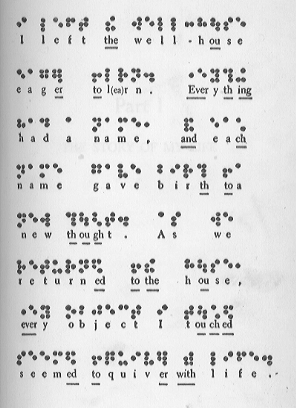
The most convenient
print for the blind is braille, which has several variations, too many,
indeed–English, American, New York Point. Miss Keller reads them all. Most
educated blind people know several, but it would save trouble if, as Miss
Keller suggests, English braille were universally adopted. The facsimile on page xvgives an idea of how the raised dots look. Each
character (either a letter or a special braille contraction) is a combination
made by varying the place and number points in six possible positions. Miss
Keller has a braille writer on which she keeps notes and writes letters to her
blind friends. There are six keys, and by pressing different combinations at a stroke
(as one plays a chord on the piano) the operator makes a character at a time in
a sheet of thick paper, and can write about half as rapidly as on a typewriter.
Braille is especially useful in making single manuscript copies of books.
Books for the blind are
very limited in number. They cost a great deal to publish and they have not a
large enough sale to make them profitable to the publisher, but there are
several institutions with special funds to pay for embossed books. Miss Keller
is more fortunate than most blind people in the kindness of her friends who
have books made especially for her, and in the willingness of gentlemen, like
Mr. E. E. Allen of the Pennsylvania Institute for the Instruction of the Blind,
to print, as he has on several occasions, editions of books that she has
needed.
Miss Keller does not as
a rule read very fast, but she reads deliberately, not so much because she
feels the words less quickly than we see them, as because it is one of her
habits of mind to do things thoroughly and well. When a passage interests her,
or she needs to remember it for some future use, she flutters it off swiftly on
the fingers of her right hand. Sometimes this finger-play is unconscious. Miss
Keller talks to herself absent-mindedly in the manual alphabet. When she is
walking up or down the hall or along the veranda, her hands go flying along
beside her like a confusion of birds' wings.
There is, I am told, tactile
memory as well as visual and aural memory. Miss Sullivan says that both she and
Miss Keller remember "in their fingers" what they have said. For Miss
Keller to spell a sentence in the manual alphabet impresses it on her mind just
as we learn a thing from having heard it many times and can call back the
memory of its sound.Like every deaf or blind person, Miss Keller depends on her sense of smell to an unusual degree. When she was a little girl she smelled everything and knew where she was, what neighbour's house she was passing, by the distinctive odours. As her intellect grew she became less dependent on this sense. To what extent she now identifies objects by their odour is hard to determine. The sense of smell has fallen into disrepute, and a deaf person is reluctant to speak of it. Miss Keller's acute sense of smell may account, however, in some part for that recognition of persons and things which it has been customary to attribute to a special sense, or to an unusual development of the power that we all seem to have of telling when some one is near.
The question of a special "sixth sense," such as people have ascribed to Miss Keller, is a delicate one. This much is certain, she cannot have any sense that other people may not have, and the existence of a special sense is not evident to her or to any one who knows her. Miss Keller is distinctly not a singular proof of occult and mysterious theories, and any attempt to explain her in that way fails to reckon with her normality. She is no more mysterious and complex than any other person. All that she is, all she has done, can be explained directly, except such things in every human being as never can be explained. She does not, it would seem, prove the existence of spirit without matter, or of innate ideas, or of immortality, or anything else that any other human being does not prove. Philosophers have tried to find out what was her conception of abstract ideas before she learned language. If she had any conception, there is no way of discovering it now; for she cannot remember, and obviously there was no record at the time. She had no conception of God before she heard the word "God," as her comments very clearly show.*
Her sense of time is excellent, but whether it would have developed as a special faculty, cannot be known, for she has had a watch since she was seven years old.
Miss Keller has two watches, which have been given her. They are, I think, the only ones of their kind in America. The watch has on the back cover a flat gold indicator which can be pushed freely around from left to right until, by means of a pin inside the case, it locks with the hour hand and takes a corresponding position. The point of this gold indicator bends over the edge of the case, round which are set eleven raised points–the stem forms the twelfth. Thus the watch, an ordinary watch with a white dial for the person who sees, becomes for a blind person by this special attachment in effect one with a single raised hour hand and raised figures. Though there is less than half an inch between the points–a space which represents sixty minutes–Miss Keller tells the time almost exactly. It should be said that any double-case watch with the crystal removed serves well enough for a blind person whose touch is sufficiently delicate to feel the position of the hands and not disturb or injure them.
The finer traits of Miss Keller's character are so well known that one needs not say much about them. Good sense, good humour, and imagination keep her scheme of things sane and beautiful. No attempt is made by those around her either to preserve or to break her illusions. When she was a little girl, a good many unwise and tactless things that were said for her benefit were not repeated to her, thanks to the wise watchfulness of Miss Sullivan. Now that she has grown up, nobody thinks of being less frank with her than with any other intelligent young woman. What her good friend, Charles Dudley Warner, wrote about her in Harper's Magazine in 1896 was true then, and it remains true now:
"I believe she is the purest-minded human being ever in existence...The world to her is what her own mind is. She has not even learned that exhibition on which so many pride themselves, of 'righteous indignation.'
"Some time ago, when a policeman shot dead her dog, a dearly loved daily companion, she found in her forgiving heart no condemnation for the man; she only said, 'If he had only known what a good dog she was, he wouldn't have shot her.' It was said of old time, 'Lord forgive them, they know not what they do!'
"Of course the question will arise whether, if Helen Keller had not been guarded from the knowledge of evil, she would have been what she is to-day.... Her mind has neither been made effeminate by the weak and silly literature, nor has it been vitiated by that which is suggestive of baseness. In consequence her mind is not only vigorous, but it is pure. She is in love with noble things, with noble thoughts, and with the characters of noble men and women."
She still has a childlike aversion to tragedies. Her imagination is so vital that she falls completely under the illusion of a story, and lives in its world. Miss Sullivan writes in a letter of 1891:
"Yesterday I read to her the story of 'Macbeth,' as told by Charles and Mary Lamb. She was very greatly excited by it, and said: 'It is terrible! It makes me tremble!' After thinking a little while, she added, 'I think Shakespeare made it very terrible so that people would see how fearful it is to do wrong.' "
Of the real world she knows more of the good and less of the evil than most people seem to know. Her teacher does not harass her with the little unhappy things; but of the important difficulties they have been through, Miss Keller was fully informed, took her share of the suffering, and put her mind to the problems. She is logical and tolerant, most trustful of a world that has treated her kindly.
Once when some one asked her to define "love," she replied, "Why, bless you, that is easy; it is what everybody feels for everybody else."
"Toleration," she said once, when she was visiting her friend Mrs. Laurence Hutton, "is the greatest gift of the mind; it requires the same effort of the brain that it takes to balance oneself on a bicycle."
She has a large, generous sympathy and absolute fairness of temper. So far as she is noticeably different from other people she is less bound by convention. She has the courage of her metaphors and lets them take her skyward when we poor self-conscious folk would think them rather too bookish for ordinary conversation. She always says exactly what she thinks, without fear of the plain truth; yet no one is more tactful and adroit than she in turning an unpleasant truth so that it will do the least possible hurt to the feelings of others. Not all the attention that has been paid her since she was a child has made her take herself too seriously. Sometimes she gets started on a very solemn preachment. Then her teacher calls her an incorrigible little sermonizer, and she laughs at herself. Often, however, her sober ideas are not to be laughed at, for her earnestness carries her listeners with her. There is never the least false sententiousness in what she says. She means everything so thoroughly that her very quotations, her echoes from what she has read, are in truth original.
Her logic and her sympathy are in excellent balance. Her sympathy is of the swift and ministering sort which, fortunately, she has found so often in other people. And her sympathies go further and shape her opinions on political and national movements. She was intensely pro-Boer and wrote a strong argument in favour of Boer independence. When she was told of the surrender of the brave little people, her face clouded and she was silent a few minutes. Then she asked clear, penetrating questions about the terms of the surrender, and began to discuss them.
Both Mr. Gilman and Mr. Keith, the teachers who prepared her for college, were struck by her power of constructive reasoning; and she was excellent in pure mathematics, though she seems never to have enjoyed it much. Some of the best of her writing, apart from her fanciful and imaginative work, is her exposition in examinations and technical themes, and in some letters which she found it necessary to write to clear up misunderstandings, and which are models of close thinking enforced with sweet vehemence.
She is an optimist and an idealist.
"I hope," she writes in a letter, "that L— isn't too practical, for if she is, I'm afraid she'll miss a great deal of pleasure."
In the diary that she kept at the Wright-Humason School in New York, she wrote on October 18, 1894, "I find that I have four things to learn in my school life here, and indeed, in life–to think clearly without hurry or confusion, to love everybody sincerely, to act in everything with the highest motives, and to trust in dear God unhesitatingly."
LITERARY STYLE
NO one can have read Miss
Keller's autobiography without feeling that she writes unusually fine English.
Any teacher of composition knows that he can bring his pupils to the point of
writing without errors in syntax or in the choice of words. It is just this
accuracy which Miss Keller's early education fixes as the point to which any
healthy child can be brought, and which the analysis of that education accounts
for. Those who try to make her an exception, not to be explained by any such
analysis of her early education, fortify their position by an appeal to the
remarkable excellence of her use of language even when she was a child.This appeal is to a certain degree valid; for, indeed, those additional harmonies of language and beauties of thought which make style are the gifts of the gods. No teacher could have made Helen Keller sensitive to the beauties of language and to the finer interplay of thought which demands expression in melodious word groupings.
At the same time the inborn gift of style can be starved or stimulated. No innate genius can invent fine language. The stuff of which good style is made must be given to the mind from without and given skilfully. A child of the muses cannot write fine English unless fine English has been its nourishment. In this, as in all other things, Miss Sullivan has been the wise teacher. If she had not had taste and an enthusiasm for good English, Helen Keller might have been brought up on the "Juvenile Literature," which belittles the language under pretence of being simply phrased for children; as if a child's book could not, like "Treasure Island" or "Robinson Crusoe" or the "Jungle Book," be in good style.
If Miss Sullivan wrote fine English, the beauty of Helen Keller's style would, in part, be explicable at once. But the extracts from Miss Sullivan's letters and from her reports, although they are clear and accurate, have not the beauty which distinguishes Miss Keller's English. Her service as a teacher of English is not to be measured by her own skill in composition. The reason why she read to her pupil so many good books is due, in some measure , to the fact that she had so recently recovered her eyesight. When she became Helen Keller's teacher she was just awakening to the good things that are in books, from which she had been shut out during her years of blindness.
In Captain Keller's library she found excellent books, Lamb's "Tales from Shakespeare," and better still, Montaigne. After the first year or so of elementary work, she met her pupil on equal terms, and they read and enjoyed good books together.
Besides the selection of good books, there is one other cause for Miss Keller's excellence in writing, for which Miss Sullivan deserves unlimited credit. That is her tireless and unrelenting discipline, which is evident in all her work. She never allowed her pupil to send off letters which contained offenses against taste, but made her write them over until they were not only correct, but charming and well phrased.
Any one who has tried to write knows what Miss Keller owes to the endless practice which Miss Sullivan demanded of her. Let a teacher with a liking for good style insist on a child's writing a paragraph over and over again until it is more than correct, and he will be training, even beyond his own power of expression, the power of expression in the child.
How far Miss Sullivan carried this process of refinement and selection is evident from the humorous comment of Dr. Bell, that she made her pupil a little old woman, too widely different from ordinary children in her maturity of thought. When Dr. Bell said this he was arguing his own case. For it was Dr. Bell who first saw the principles that underlie Miss Sullivan's method, and explained the process by which Helen Keller absorbed language from books.
There is, moreover, a reason why Helen Keller writes good English, which lies in the very absence of sight and hearing. The disadvantages of being deaf and blind were overcome and the advantages remained. She excels other deaf people because she was taught as if she were normal. On the other hand, the peculiar value to her of language, which ordinary people take for granted as a necessary part of them, like their right hand, made her think about language and love it. Language was her liberator, and from the first she cherished it.
The proof of Miss Keller's early skill in the use of English, and the final comment on the excellence of this whole method of teaching, is contained in an incident, which, although at the time it seemed unfortunate, can no longer be regretted. I refer to the "Frost King" episode, which I shall explain in detail. Miss Keller has given her account of it, and the whole matter was discussed in the first Volta Bureau Souvenir from which I quote at length:
Helen
Keller began writing The
Story of My Life in 1902,
when she was 22 years old and still a student at Radcliffe College, the sister
school of Harvard University in Cambridge, Massachusetts.
The Story of My Life contains three parts. The first is Helen
Keller's autobiographical account of her life from childhood to the beginning
of her studies at Radcliffe. This chronicle describes the transformation of
Helen's life brought about by the arrival of Anne Sullivan, her teacher and
mentor, when she succeeded in conveying to Helen the "mystery of language."
Part II contains Helen's letters to family and friends, arranged in
chronological sequence, and documents her growth in thought and expression
through her writing. The introduction and editorial comments in this section
were contributed by John Macy, an editor of the Youth's Companion magazine and an instructor at Harvard
who became the literary agent for Ms. Keller and editor of many of her works.
The third part, a supplementary section, contains an account of Helen Keller's
life and education written by John Macy, based for the most part on the records
and observations of Anne Sullivan.
The Story of My Life first appeared as a serial of several
installments in the Ladies
Home Journal in 1902 and was
met with universal acclaim. In 1903 it was published in book form by Doubleday,
Page & Co. and became a critical and commercial success.
The Story of My Life has become an enduring classic of
American literature. It was always to be the most popular of Helen Keller's
works, with numerous editions published throughout the years. Today, the book
is available in more than 50 languages, including most European languages,
Swedish, Russian, and Japanese, as well as Marathi, Pushtu, Tagalog, and Vedu.
The American Foundation for the
Blind—the organization to which Helen Keller devoted more than 40 years of her
life—is presenting this special online edition of The Story of My Life to commemorate the centennial of the
book's publication. Throughout this edition, spelling and punctuation are
rendered as they were in the original. The photographs, taken from the Helen Keller Archives of the American Foundation for the
Blind, are for the most part those printed in the original. When an original
photograph was unavailable, the closest possible facsimile was used.
AFB was founded in 1921 and for decades
guided by Helen Keller—an inspiring, courageous woman who fervently believed
that blind people, with just a little help, can lead independent lives and give
much more to society than they will ever take. Today, there are many more
people, from newborns to the growing elder population, in need of a helping
hand than Helen Keller ever imagined. With your support, the American Foundation for the Blind can
reach out to those who need help. Thank you for your support.
Helen
Keller, the little deaf and blind girl was triumphed over adversity to become
world famous. Helen was born on June 27, 1880 in Tuscumbia, Alabama, to
Captain Arthur Henry Keller, a confederate army veteran and a newspaper editor,
and Kate Adams Keller. By all accounts, she was a normal
child. But at 19 months, Helen suffered an illness – scarlet fever or
meningitis that left her deaf and blind. Although Helen learned basic
household tasks and could communicate some of her desires through a series of
signs, she did not learn language the way other children do. Indeed, her
family wondered how a deaf and blind child could be educated. At the age
of six, her mother managed to get a teacher, Anne Sullivan, to teach
Helen. After studying at the Wright Humason School for the Deaf and the
Cambridge School for Young ladies, Helen entered Radcliff College in 1900 and
finished her graduation in 1904.
The Story
of My Life shows, Helen Keller’s life is neither a miracle nor a joke. It
is a tremendous achievement. It is destined to be imprisoned in darkness
and isolation for the rest of her life, Helen built upon the brilliant work of
her teacher, Anne Sullivan, to become an inter-nationally recognized and
respected figure. In 1908 Helen published “The World I Live In”, an
account of how she experienced the world through touch, taste and scent.
In magazine articles she advocated for increased opportunities for the blind
and for improving methods of reducing childhood blindness. In 1909, Helen
joined the Socialist Party of Massachusetts and supported many progressive era
causes, including birth control, labour unions and the right of women to
vote. In 1924, her popularity somewhat recovered, Helen began working as
a lecturer fund-raiser for the American Foundation for the Blind (AFB).
Helen was
devastated when her companion Anne Sullivan died in 1936. After the
Second World War she toured more than thirty countries, continuing her advocacy
for the blind. In 1955, she published the biography of Anne Sullivan
“Teacher”, and in 1957 “The Open door”, a collection of essays. In 1964
she was awarded the Presidential Medal of Freedom, the nation’s highest
civilian honor, by President Lyndon Johnson. On 1st June, 1968, she died at her home in
Arcane Ridge, Connecticut.
I n the
second part of the book, we can read the letters written by Helen to her
beloved ones during 1887-1901. It was quite interesting and informative
with wonder and curiosity. Through these letters, she opened her mind,
saw, felt and touched the worlds of wonders. They are exercises which
have trained her to write. The book “Story of My Life” is a story of
courage and determination and a work of inspirational literature. It is a
very good book for any kinds of libraries.
THE CANTERVILLE GHOST(XI)
The Canterville Ghost" is a popular short story by Oscar Wilde, widely adapted for the screen and stage.
It was the first of Wilde's stories to be published, appearing in the magazine The Court and
Society Review in
February 1887. It was later included in a collection of short stories entitled Lord
Arthur Savile's Crime and Other Stories in 1891.
Setting
The story of the Canterville Ghost takes
place in an old English country house, Canterville Chase, which
has all the accoutrements of a traditional haunted house. Descriptions of the
wainscotting, the library paneled in black oak, and the armor in the hallway
characterize the Gothic setting and help Wilde clash the Old
World with the New. Typical of the style of the English Decadents,[citation needed] the gothic
atmosphere reveals the author’s fascination with the macabre. Yet he mixes the
macabre with comedy, juxtaposing devices from traditional English ghost stories
such as creaking floorboards, clanking chains, and ancient prophecies with
symbols of modern American consumerism. Wilde’s Gothic setting helps emphasize
the contrast between cultures—setting modern Americans in what could arguably
be a classic symbol of British history—and underscores the "modern"
thinking of the house's mismatched residents, the Otises.
Plot
Plot

Illustrations by Frederick Henry Townsend from The Court and Society
Review, February 23 and March 2,
1887.
The story begins when Mr Otis's family shifted to Canterville
Chase, despite warnings from Lord Canterville that the house is haunted. The
Otis family includes Mr. and Mrs. Otis, their daughter Virginia, twin boys
(often referred to as "Stars and Stripes") and their oldest son
Washington. At first, not one member of the Otis family believes in ghosts, but
shortly after they move in, none of them can deny the presence of Sir Simon
(The Ghost). The family hears clanking chains, they witness re-appearing
bloodstains "on the floor just by the fireplace", and they see
strange apparitions in various forms. But, humorously, none of these scare the
Otises in the least. In fact, upon hearing the clanking noises in the hallway,
Mr. Otis promptly gets out of bed and pragmatically offers the ghost Tammany
Rising Sun Lubricator to oil his chains.
Despite Sir Simon’s attempts to appear in the most gruesome
guises, the family refuses to be frightened, and Sir Simon feels increasingly
helpless and humiliated. When Mrs. Otis notices a mysterious red mark on the
floor, she simply replies that she does “not at all care for blood stains in
the sitting room.” When Mrs. Umney, the housekeeper, informs Mrs. Otis that the
blood stain is indeed evidence of the ghost and cannot be removed, Washington
Otis, the oldest son, suggests that the stain will be removed with Pinkerton’s
Champion Stain Remover and Paragon Detergent: A quick fix, like the Tammany
Rising Sun Lubricator, and a practical way of dealing with the problem.
Wilde describes Mrs. Otis as “a very handsome middle-aged woman”
who has been “a celebrated New York
The most colourful character in the story is undoubtedly the ghost
himself, Sir Simon, who goes about his duties with theatrical panache and
flair. He assumes a series of dramatic roles in his failed attempts to impress
and terrify the Otises, making it easy to imagine him as a comical character in
a stage play. The ghost has the ability to change forms, so he taps into his
repertoire of tricks. He takes the role of ghostly apparitions such as a
Headless Earl, a Strangled Babe, the Blood-Sucker of Bexley Moor, Jonas the
Graveless, Suicide’s Skeleton, and the Corpse-Snatcher of Chertsey Barn, all
having succeeded in horrifying previous castle residents over the centuries.
But none of them works with these Americans. Sir Simon schemes, but even as his
costumes become increasingly gruesome, his antics do nothing to scare his house
guests, and the Otises succeed in failing him every time. He falls victim to
trip wires, pea shooters, butter-slides, and falling buckets of water. In a
particularly comical scene, he is frightened by the sight of a “ghost,” rigged
up by the mischievous twins.
During the course of the story, as narrated from Sir Simon's
viewpoint, we come to understand the complexity of the ghost’s emotions. We see
him brave, frightening, distressed, scared, and finally, depressed and weak. He
exposes his vulnerability during an encounter with Virginia, Mr. Otis's
fifteen-year-old daughter. Virginia Virginia
Unlike the rest of her family, Virginia Garden of Death Virginia
Story
“The Canterville Ghost” is a study in contrasts. Wilde takes an
American family, places them in a British setting, then, through a series of
mishaps, pits one culture against the other. He creates stereotypical
characters that represent both England
and the United States England England
and the United States
The story illustrates Wilde’s tendency to reverse situations into
their opposites as the Otises gain the upper hand and succeed in terrorizing
the ghost rather than be terrorized by him. Wilde pairs this reversal of
situations with a reversal of perspective. This ghost story is told not from
the perspective of the castle occupants, as in traditional tales, but from the
perspective of the ghost, Sir Simon. In this sense, Sir Simon could logically
be labeled the “protagonist” in this story, as it is he who faces the challenge
of overcoming adversity and bettering his “life.”
Though Wilde tells a humorous tale, it appears that he also has a
message, and he uses fifteen-year-old Virginia Virginia Virginia Virginia
The
Canterville Ghost’s characters
The ghost: It
is the ghost of the castle for centuries. He was Sir Simon de Canterville and
died in 1584, his spirit still haunts the Chase. His aspect is very terrible:
“He is an old man, his eyes were as red burning coals, long grey hair fell over
his shoulders in matted coils, his garments, which were of antique cut, were
soiled and ragged, and from his wrists and ankles hung heavy manacles and rusty
gyves.”
Mr. Otis: He is the father of the
Otis family. He is a middle-aged American minister; he is determinate,
inflexible, rational, practical and pragmatic, in conclusion a true American.
In fact at the beginning he believes that the ghost doesn’t exist, then, when
he personally meets him, he is indifferent: he has more important things to do,
making money, for example.
The twins: They
are usually called the Stars and Stripes; they are delightful boys and the only
true republicans of the family.” These children always play tricks on the ghost
and make him depressed and desperate. All along the story, they imagine jokes
and even dress up as ghosts.
Mrs. Otis: The
mother isn't scared of the ghost and even asks him if he wants a remedy for his
stomach. She is a very pretty middle-aged woman with fine eyes and a superb
profile. She has a magnificent constitution and a wonderful amount of animal
spirits.
Duke of Cheshire Eton , and he must wait to marry.
When Virginia Virginia
Lord Canterville: A respectable descendent of the Canterville family, that was the
owner of the Canterville Chase. “He is an English man of the most punctilious
honor.”
Mrs. Umney: The
old house-keeper of Canterville Chase is very terrified by the ghost and tries
to warn the family.
Wit and
Humor
Humor is the most powerful weapon used by Wilde to defuse the
tension and scary atmosphere that would have resulted in such a ghost story.
Phantoms, apparitions, blood stains, haunting of the ghost in the corridors are
all treated with humor. The persistent blood stain is wiped with Pinkerton's
stain remover, Mrs. Umney's fainting fit are to be charged like breakages, the
ghost appears in a miserable state that shocks no one. Mr. Otis scolds the
ghost and offers him Lubricator to oil his chains, when the ghost laughs demoniacally,
Mrs. Otis accuses him of indigestion and offers him tincture. The ghost feels
duty bound and says, "I must rattle my chains, groan through keyholes,
walk about at night." Oscar Wilde treats even murder non-seriously. Sir
Simon murdered his wife because she was not a good cook nor could do repair
work. Mrs. Otis does not pretend to be stick as part of 'European Refinement',
she is 'handsome'. The ghost becomes frustated because the Otises are incapable
of appreciaing the symbolic value of apparitions, blood stains, development of
astral bodies and do not have any importance to his Solomon duty to haunt the
castle. All the tricks played on the ghost are funny, the best being, having to
encounter another ghost, which frightens the Canterville ghost.
The Canterville Ghost'' was
first published serially in 1887 in Court and Society Review, a magazine for the leisured upper classes. The
story did not immediately receive much critical attention, and indeed Wilde was
not viewed as an important author until the publication, during the 1890s, of
his novel The Picture of Dorian Gray (1891) and of several well-received
plays, including The Importance of Being Earnest (1895). In 1891, ‘‘The Canterville
Ghost’’ was republished in Lord Arthur Savile's Crime, and Other Stories.
The collected stories were
severely criticized by contemporary reviewers; early critics found Wilde's work
unoriginal and derivative. More recently critics have celebrated Wilde's
ability to play with the conventions of many genres. In ‘‘The Canterville
Ghost,’’ Wilde draws upon fairy tales, Gothic novels, and stories of Americans
abroad to shape his comic ghost story. Though Wilde offers a comic treatment,
he finds inspiration for Sir Simon's character in Alfred Tennyson's serious
poem "Maud," as well as in the Romantic poet Samuel Taylor
Coleridge's "Christabel." Critics also point to the possible
influence of Henry James's Portrait of a Lady (1881)
on ‘‘The Canterville Ghost.’’
Wilde used a myriad of
comic sources to shape his story. Thomas De Quincey's ‘‘Murder Considered as
One of the Fine Arts,’’ a satirical essay, is one apparent source. Wilde would
also have been aware of Jane Austen's Northanger Abbey (1818),
a parody of the Gothic novel so popular in the early nineteenth century.
Finally, Wilde's own experience on the lecture circuit in the United States
THE HOUNDS OF BASKERVILLE(XII)
Main characters
Sherlock Holmes – Holmes is the famed 221B Baker Street detective with a keen eye, acute intelligence and a logical mind.
He is observation and deduction personified, and although he takes a back seat
to Watson for much of this particular adventure, we always feel his presence.
In the end, it takes all of his crime-solving powers to identify an ingenious
killer, save the life of his next intended victim, and solve the Baskerville
mystery.
Dr John Watson – The novel's narrator, Watson is Holmes's stalwart assistant at
Baker Street and the chronicler of his triumphs as a private investigator. He
steps into Holmes's boots for awhile, expressing his eagerness to impress his
colleague by cracking this most baffling of cases before Holmes returns to the
fray.
Sir Hugo Baskerville – The 17th-century Baskerville who spawned the legend of the
family curse. Sir Hugo was a picture of aristocratic excess, drunkenness and
debauchery until, one night, he was reputedly killed near Baskerville Hall, in
the wilds of Dartmoor, by a demonic hound sent to punish his wickedness.
Sir Charles Baskerville – The recently deceased owner of the Baskerville estates in Devon,
Sir Charles was a superstitious bachelor in waning health. Long terrified by
the Baskerville legend, his footprints show that he must have been fleeing from
something at the time of his death in the grounds of Baskerville Hall.
Furthermore, the paw-prints of a large dog marked the soil near his corpse. Sir
Charles had been a philanthropist. His enlightened plans to invest funds in the
isolated district surrounding Baskerville Hall prompt his heir, Sir Henry, to
want to move there and continue his uncle's good works.
Sir Henry Baskerville – The late Sir Charles's nephew and closest known relative, Henry
Baskerville inherits the baronetcy. He is described as "a small, alert,
dark-eyed man about thirty years of age, very sturdily built." Sir Henry
is introduced by his doctor to Holmes and Watson, who travel to Devon in order
protect him from what may be a plot to kill him and thus eliminate the last of
the Baskervilles. At the climax of the story, Sir Henry is almost killed, like
his uncle, by a ferocious hound, kept hidden among the mires of Dartmoor and
trained by the villain of the story to prey on selected victims.
Dr James Mortimer – A medical practitioner and friend of the Baskervilles. Mortimer
is tall, thin and good-natured with rather eccentric habits. He is,
nonetheless, a competent country doctor who was made the executor of Sir
Charles's will. He sets the book's plot in train by travelling to London to
inform Holmes and Watson about the strange events surrounding Sir Charles's
demise, and alerting them to the dangerous situation that Sir Henry now faces
as Sir Charles's heir. Mortimer continues to assist Holmes and Watson in their
twin roles as investigators and bodyguards until the conclusion of the case.
Jack Stapleton – A bookish former
schoolmaster, Stapleton chases butterflies on the moors and pursues antiquarian
interests. Outwardly a polished gentleman, he inwardly possesses a hot temper
which reveals itself at key moments. It transpires that Stapleton—in reality a
long-lost relative of Sir Henry's who stands to inherit the Baskerville
fortune—is a scheming, manipulative and money-hungry criminal.
Miss Beryl Stapleton – Allegedly Stapleton's sister, this dusky beauty turns out to be
his wife. Eager to prevent another death, but terrified of her violent spouse,
she provides enigmatic warnings to Sir Henry and Watson.
John and Eliza Barrymore – The longtime domestic servants of the Baskervilles. Earnest and
eager to please, Mrs Barrymore and her husband harbour a dark family secret,
however, which temporarily misleads Watson about what is happening out on the
moors.
Laura Lyons – The attractive
daughter of a local crank who disowned her when she married against his wishes.
Subsequently abandoned by her husband, she turns to Stapleton and Sir Charles
Baskerville for help, with fatal consequences for the latter.
Selden – A dangerous criminal
hiding from the police on the moors. He has a link to the Barrymores, who
clandestinely supply him with food and clothing at night. Selden is
inadvertently killed by the hound while dressed in a discarded suit of Sir
Henry's clothes.
Introduction
Sir Charles Baskerville is found
dead on the grounds of his country house, Baskerville Hall. The cause is
ascribed to a heart attack. Fearing for the safety of Sir Charles's nephew and
only known heir, Sir Henry Baskerville, coming from America to claim his
inheritance, Dr James Mortimer travels to London and asks Sherlock Holmes for
help.
Mortimer explains that the
Baskerville family is afflicted by a curse. According to an old account, over
two centuries ago Hugo Baskerville was infatuated with a farmer's daughter. He
kidnapped her and imprisoned her in his bedroom. She escaped and the furious
Baskerville offered his soul to the devil if he could recapture her. Aided by
friends, he pursued the girl onto the desolate moor.
Baskerville and his victim were found dead. She had died from fright, but a
giant spectral hound stood guard over Baskerville's body. The hound tore out
Baskerville's throat, then vanished into the night.
Sir Charles Baskerville had
become fearful of the legendary curse and its hellhound.
Mortimer decided that Sir Charles had been waiting for someone when he died.
His face was contorted in a ghastly expression, while his footprints suggested
he was running from something. The elderly man's heart was not strong, and he
had planned to go to London the next day. Mortimer says he had seen the
footprints of a "gigantic hound" near Sir Charles's body, something
not revealed at the inquest.
In London
Intrigued by the case, Holmes meets with Sir Henry, newly arrived
from America. Sir Henry is puzzled by an anonymous note delivered to his London
hotel room, warning him to avoid the Devonshire moors. Holmes says that the
note had been composed largely of letters cut from The Times, probably in a hotel, judging by other clues. The fact that the
letters were cut with nail scissors suggested an authoress, as did a remnant
whiff of perfume. Holmes keeps this last detail to himself. When Holmes and
Watson later join Sir Henry at his hotel, they learn one of the baronet's new
boots has gone missing. No good explanation can be found for the loss.
Holmes asks if there were any other living relatives besides Sir
Henry. Mortimer tells him that Charles had two brothers, Rodger and John. Sir
Henry is the sole child of John, who settled in America and raised his son
there. Another brother, Rodger, was known to be the black sheep of the family. A wastrel and inveterate gambler, he fled to South
America to avoid creditors. He is believed to have died there alone.
Despite the note's warning, Sir Henry insists on visiting
Baskerville Hall. As Sir Henry leaves Holmes' Baker Streetapartment, Holmes and Doctor Watson follow him. They realise that
a man with a fake-looking black beard in a cab is also following him. Holmes
and Watson pursue this man, but he escapes; however, Holmes memorises the cab
number. Holmes stops in at a messenger office and employs a young boy,
Cartwright, to go visit London's hotels and look through wastepaper in search
of cut-up copies of The Times.
By the time they return to the hotel, Sir Henry has had another,
older boot stolen. When the first missing boot is discovered before the meeting
is over, Holmes begins to realise they must be dealing with a real hound (hence
the emphasis on the scent of the used boot). When conversation turns to the man
in the cab, Mortimer says that Barrymore, the servant at Baskerville Hall, has
a beard, and a telegram is sent to check on his whereabouts.
At
Baskerville Hall
It is decided that, with Holmes
being tied up in London with other cases, Watson will accompany Sir Henry to
Baskerville Hall and report back by telegram in detail. Later that evening,
telegrams from Cartwright (who was unable to find the newspaper) and
Baskerville Hall (where Barrymore apparently is) bring an end to those leads. A
visit from John Clayton, who was driving the cab with the black-bearded man, is
of little help. He says that the man had identified himself as Holmes, much to
the surprise and amusement of the actual Holmes.
Mortimer, Watson, and Sir Henry
set off for Baskerville Hall the following Saturday. The baronet is excited to
see it and his connection with the land is clear, but finds the moor dampened.
Soldiers are about the area, on the lookout for an escaped murderer named
Selden. Barrymore and his wife wish to depart Baskerville Hall as soon as is
convenient, and the Hall is, in general, a somber place. Watson has trouble
sleeping that night, and hears a woman crying. The next morning Barrymore
denies that it was his wife, who is one of only two women in the house. Watson
sees Mrs. Barrymore later in the morning, however, and observes clear evidence
that she has indeed been weeping.
Watson checks with the postmaster
in Coombe Tracey and learns that the telegram was not actually delivered into
the hands of Barrymore, so it is no longer certain that he was at the Hall, and
not in London. On his way back, Watson meets Jack Stapleton, a naturalist
familiar with the moor even though he has only been in the area for two years.
They hear a moan that the peasants attribute to the hound, but Stapleton
attributes it to the cry of a bittern, or
possibly the bog settling. He then runs off after a specimen of the butterflyCyclopedes, which
was still found on Dartmoor until the 1860s. Watson is not alone for long
before Beryl Stapleton, Jack's sister, approaches him. Mistaking him for Sir
Henry, she urgently warns him to leave the area, but drops the subject when her
brother returns. The three walk to Merripit House (the Stapletons’ home), and
during the discussion, Watson learns that Stapleton used to run a school in
Yorkshire. Though he is offered lunch and a look at Stapleton’s collections,
Watson departs for the Hall. Before he gets far along the path, Miss Stapleton
overtakes him and retracts her warning. Watson notices that the brother and
sister don't look very much alike.
Sir Henry soon meets Miss
Stapleton and becomes romantically interested, despite her brother’s
intrusions. Watson meets another neighbour, Mr. Frankland, an elderly lawyer.
Barrymore draws increasing suspicion, as Watson and Sir Henry see him late at
night walk with a candle into an empty room, hold it up to the window, and then
leave. Realising that the room has a view out on the moor, Watson and Sir Henry
determine to figure out what is going on.
Meanwhile, during the day, Sir
Henry continues to pursue Beryl Stapleton until her brother runs up on them and
yells angrily. He later explains to the disappointed baronet that it was not
personal, he was just afraid of losing his only companion so quickly. To show
there are no hard feelings, he invites Sir Henry to dine with him and his
sister on Friday.
The
convict
Sir Henry then becomes the person
doing the surprising, when he and Watson walk in on Barrymore, catching him at
night in the room with a candle. Barrymore refuses to answer their questions,
since it is not his secret to tell, but Mrs. Barrymore’s. She tells them that
the runaway convict Selden is her brother and the candle is a
signal to him that food has been left for him. When the couple return to their
room, Sir Henry and Watson go off to find the convict, despite the poor weather
and frightening sound of the hound. They see Selden by another candle, but are
unable to catch him. Watson notices the outlined figure of another man standing
on top of a tor with the
moon behind him, but he likewise gets away.
Barrymore is upset when he finds
out that they tried to capture Selden, but when an agreement is reached to
allow Selden to flee the country, he is willing to repay the favour. He tells
them of finding a mostly burnt letter asking Sir Charles to be at the gate at
the time of his death. It was signed with the initials L.L. Mortimer tells
Watson the next day those initials could stand for Laura Lyons, Frankland’s
daughter. She lives in Coombe Tracey. When Watson goes to talk to her, she
admits to writing the letter in hopes that Sir Charles would be willing to help
finance her divorce, but says she never kept the appointment.
[edit]The
appearance of Holmes
Frankland has just won two law
cases and invites Watson in to help him celebrate. Barrymore had previously
told Watson that another man lived out on the moor besides Selden, and
Frankland unwittingly confirms this, when he shows Watson through his telescope
the figure of a boy carrying food. Watson departs the house and goes in that
direction. He finds the prehistoric stone dwelling where the unknown man has
been staying, goes in, and sees a message reporting on his own activities. He
waits, revolver at the ready, for the unknown man to return.
The unknown man proves to be
Holmes. He has kept his location a secret so that Watson would not be tempted
to come out and so he would be able to appear on the scene of action at the
critical moment. Watson’s reports have been of much help to him, and he then
tells his friend some of the information he has uncovered – Stapleton is
actually married to the woman passing as Miss Stapleton, and was also promising
marriage to Laura Lyons to get her cooperation. As they bring their conversation
to an end, they hear a ghastly scream.
They run towards the sound and
finding a body, mistake it for Sir Henry. They realise it is actually the
escaped convict Selden, the brother of Mrs Barrymore, dressed in the baronet’s
old clothes (which had been given to Barrymore by way of further apology for
distrusting him). Then Stapleton appears, and while he makes excuses for his
presence, Holmes announces that he will return to London the next day, his
investigations having produced no result.
[edit]Climax
Holmes and Watson return to
Baskerville Hall where, over dinner, the detective stares at Hugo Baskerville's
portrait. Calling Watson over after dinner he covers the hair to show the face,
revealing its striking likeness to Stapleton. This provides the motive in the
crime – with Sir Henry gone, Stapleton could lay claim to the Baskerville
fortune, being clearly a Baskerville himself. When they return to Mrs. Lyons’s
apartment, Holmes' questioning forces her to admit Stapleton’s role in the
letter that lured Sir Charles to his death. They go to the railway station to
meet Det. Inspector Lestrade, whom Holmes has called in by telegram.
Under the threat of advancing
fog, Watson, Holmes, and Lestrade lie in wait outside Merripit House, where Sir
Henry has been dining. When the baronet leaves and sets off across the moor,
Stapleton lets the hound loose. Holmes and Watson manage to shoot it before it
can hurt Sir Henry seriously, and discover that its hellish appearance was
acquired by means of phosphorus. They
find Mrs. Stapleton bound and gagged in an upstairs room of Merripit House.
When she is freed, she tells them of Stapleton’s hideout; an island deep in the
Great Grimpen Mire. They look for him next day, unsuccessfully, and he is
presumed dead, having lost his footing and being sucked down into the foul and
bottomless depths of the mire. Holmes and Watson are only able to find and
recover Sir Henry's boot used by Stapleton to give the hound Sir Henry's scent
and find the remains of Dr Mortimer's dog in the mire.
[edit]Epilogue
Some weeks later, Watson
questions Holmes about the Baskerville case. Holmes reveals that although
believed to have died unmarried, Sir Charles' younger brother Rodger
Baskerville had married and had a son with the same name as his father. The son
John Rodger Baskerville, after embezzling public money in Costa Rica, took the
name Vandeleur and fled to England where he used the money to fund a Yorkshire school. Unfortunately for him, the tutor he
had hired died of consumption, and after an epidemic of the disease killed
three students the school itself failed. Now using the name Stapleton, Baskerville/Vandeleur
fled with his wife to Dartmoor. He
apparently supported himself by burglary, engaging in four large robberies and
pistolling a page who surprised him.
Having learned the story of the
hound, he resolved to kill off the remaining Baskervilles so that he could come
into the inheritance as the last of the line. He had no interest in the estate
and simply wanted the inheritance money. He purchased the hound and hid it in
the mire at the site of an abandoned tin mine.
On the night of his death, Sir
Charles had been waiting for Laura Lyons. The cigar ash at the scene ("the
ash had twice dropped from his cigar") showed he had waited for some time.
Instead he met the hound that had been trained by Stapleton and covered with
phosphorus to give it an unearthly appearance. Sir Charles ran for his life,
but then had the fatal heart attack which killed him. Since dogs do not eat or
bite dead bodies, it left him there untouched.
Stapleton followed Sir Henry in
London, and also stole his new boot but later returned it, since it had not
been worn and thus lacked Sir Henry's scent. Holmes speculated that the hotel
bootblack had been bribed to steal an old boot of Henry's instead. The hound pursued
Selden to his death in a fall because he was wearing Sir Henry's old clothes.
On the night the hound attacked
Sir Henry, Stapleton's wife had refused to have any further part in Stapleton's
plot, but her abusive husband beat and tied her to a pole to prevent her from
warning him.
In Holmes' words: "..he
(Stapleton) has for years been a desperate and dangerous man.." It was his
consuming interest in entomology that allowed Holmes to identify him as the
same man as Vandeleur, the former schoolmaster.
[edit]Origins
Sir Arthur Conan Doyle wrote this
story shortly after returning to his home Undershaw from South Africa, where he had worked as a
volunteer physician at the Langman Field Hospital in Bloemfontein at the time of the Second
Boer War.
Conan Doyle had not written about
Sherlock Holmes in eight years, having killed off the character in the 1893
story "The Final Problem". Although The Hound of the Baskervilles is set before the latter events, two
years later Conan Doyle would bring Holmes back for good, explaining in "The Adventure of the Empty
House" that Holmes had faked his own death.
He was assisted with the plot by
a 30-year-old Daily
Express journalist
named Bertram Fletcher Robinson (1870–1907). His ideas came from the legend
of Richard Cabell, which was the fundamental inspiration for the Baskerville
tale of a hellish hound and a cursed country squire. Cabell's tomb can be seen
in the Devon town of Buckfastleigh.[3][4]
Squire Richard Cabell lived for
hunting and was what in those days was described as a 'monstrously evil man'.
He gained this reputation for, amongst other things, immorality and having sold
his soul to the Devil. There
was also a rumour that he had murdered his wife. On 5 July 1677, he died and
was laid to rest in 'the sepulchre,' but that was only the beginning of the
story. The night of his interment saw a phantom pack of hounds come baying
across the moor to howl at his tomb. From that night onwards, he could be found
leading the phantom pack across the moor, usually on the anniversary of his
death. If the pack were not out hunting, they could be found ranging around his
grave howling and shrieking. In an attempt to lay the soul to rest, the
villagers built a large building around the tomb, and to be doubly sure a huge
slab was placed .[5]
Moreover, Devon's folklore
includes tales of a fearsome supernatural dog known as the Yeth
hound that
Conan Doyle may have heard.